
Alcona Projected and Actual Release
A projected date is a calculation or eligibility marker based on the sentence information known at that time. An actual release date records a movement that already occurred. For Michigan prison records, OTIS uses PAROLE BOARD JURISDICTION DATE for the earliest release date, or ERD. This is when the Board first gains authority to consider parole. It is not a promise that parole will be granted on that date.
The historical field DATE PAROLED means the date the person left prison on parole. Parole still continues the sentence in the community. MAXIMUM DATE is a potential maximum based on the applicable sentence and available credits. A discharge at maximum can occur without parole. Each label answers a different question.
A pretrial detainee has no computed sentence-release date. A bond order may authorize release, but it does not prove that bond was posted or that no other hold applied. The jail movement record is the source for the actual custody endpoint.
A sentence-complete entry also needs context. Probation, another sentence, a warrant, or a receiving agency can remain after the custodial term ends. Likewise, a parole date ends secure prison custody but starts or continues community supervision. A discharge date is the closer match for the end of MDOC jurisdiction on the listed sentence.
Find an Alcona Projected Release Date
Start with the sentence and custodian, not a generic percentage. An Alcona arrest can end in bond release, Iosco lodging, a county sentence, or transfer to MDOC or another agency. OTIS applies only when the person falls within MDOC jurisdiction. It is not a county-jail calculator.
- Determine whether the person is pretrial, serving a county-jail term, or serving a Michigan prison sentence. Use the court case and sheriff movement record when uncertain.
- For a state prisoner, open MDOC OTIS and search by MDOC number when available.
- Match the detail record by name, date of birth, photograph, sentence county, offense, and offender number.
- Read Parole Board Jurisdiction Date, Maximum Date, status, sentence structure, and any Date Paroled together.
- For an Alcona or Iosco county-jail sentence, ask the physical custodian for its existing sentence computation and release record, then compare the judgment and jail credit.
- Confirm an error with MDOC or the sentencing court, depending on whether the source is the corrections calculation or judgment.
The full custody-classification path is available through the Alcona County released inmate lookup. It separates a county booking from state prison, federal custody, and immigration custody before a date is interpreted.
The official OTIS interface is the state starting point for a Michigan prison date search.
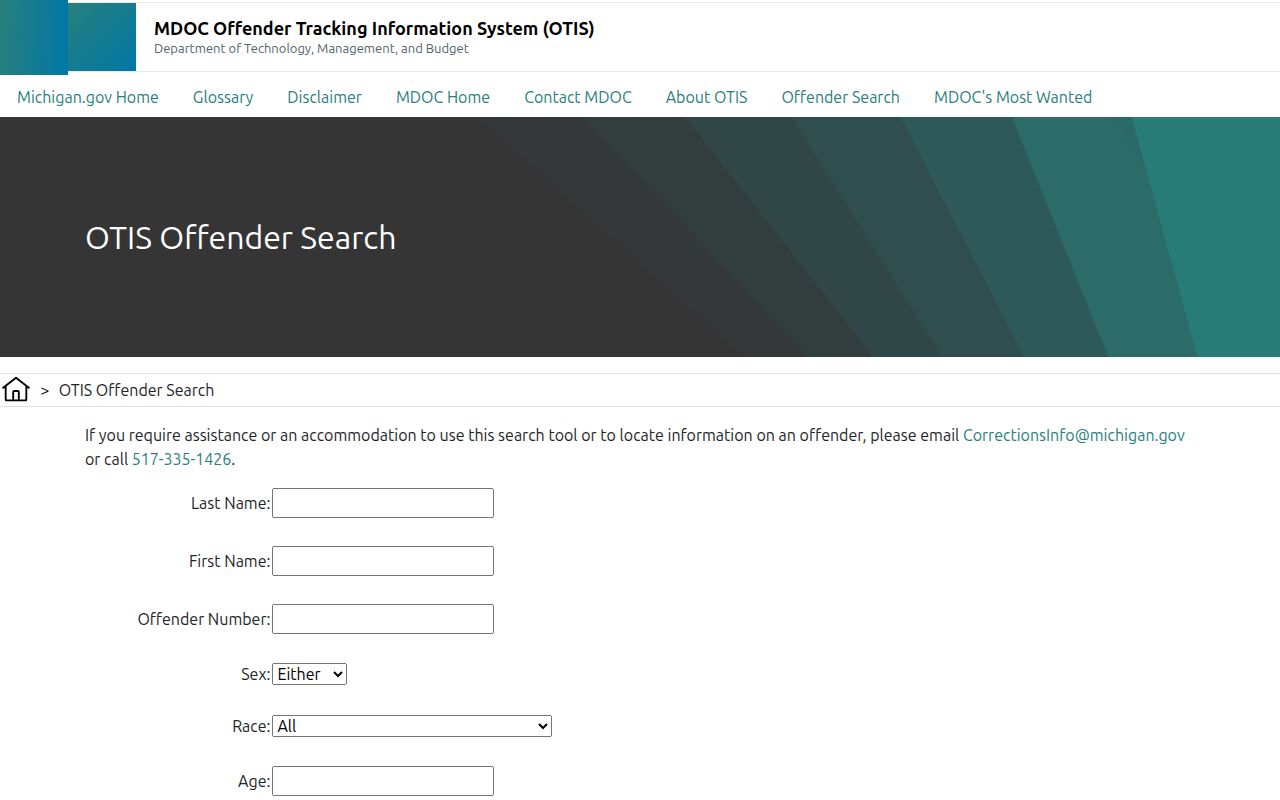
The search image shows the statewide system, which should not be used to calculate an Alcona or Iosco county-jail sentence.
Note: “Not in Alcona custody” is weak evidence because the county does not house people overnight and often routes custody to Iosco.
Michigan Prison Date Computation
Michigan generally uses a modified indeterminate sentence. The judge sets a minimum term, while statute supplies the maximum, subject to exceptions. The Parole Board ordinarily gains jurisdiction after the applicable minimum, adjusted only by credits legally available to that sentence. Reaching that point permits a decision; it does not require release. The Board can grant, deny, or defer under the governing standard.
Offense date is crucial. Older credit regimes can affect eligible sentences. MDOC describes regular good time for eligible offenses committed before April 1, 1987, with escalating monthly amounts and possible special good time. Eligible offenses in a later period can receive disciplinary credits, generally five days per month plus two special days for exceptionally good behavior. Major misconduct can cost that month's credit, and accumulated credit can be forfeited.
For a prisoner subject to disciplinary time, MCL 800.33 makes the person ineligible for good, special good, disciplinary, and special disciplinary credits. The rule cannot be applied without the offense date and sentence classification. A modern truth-in-sentencing term must not be shortened with an old formula.
The official MCL 800.33 text shows why the controlling credit regime must be checked rather than assumed.
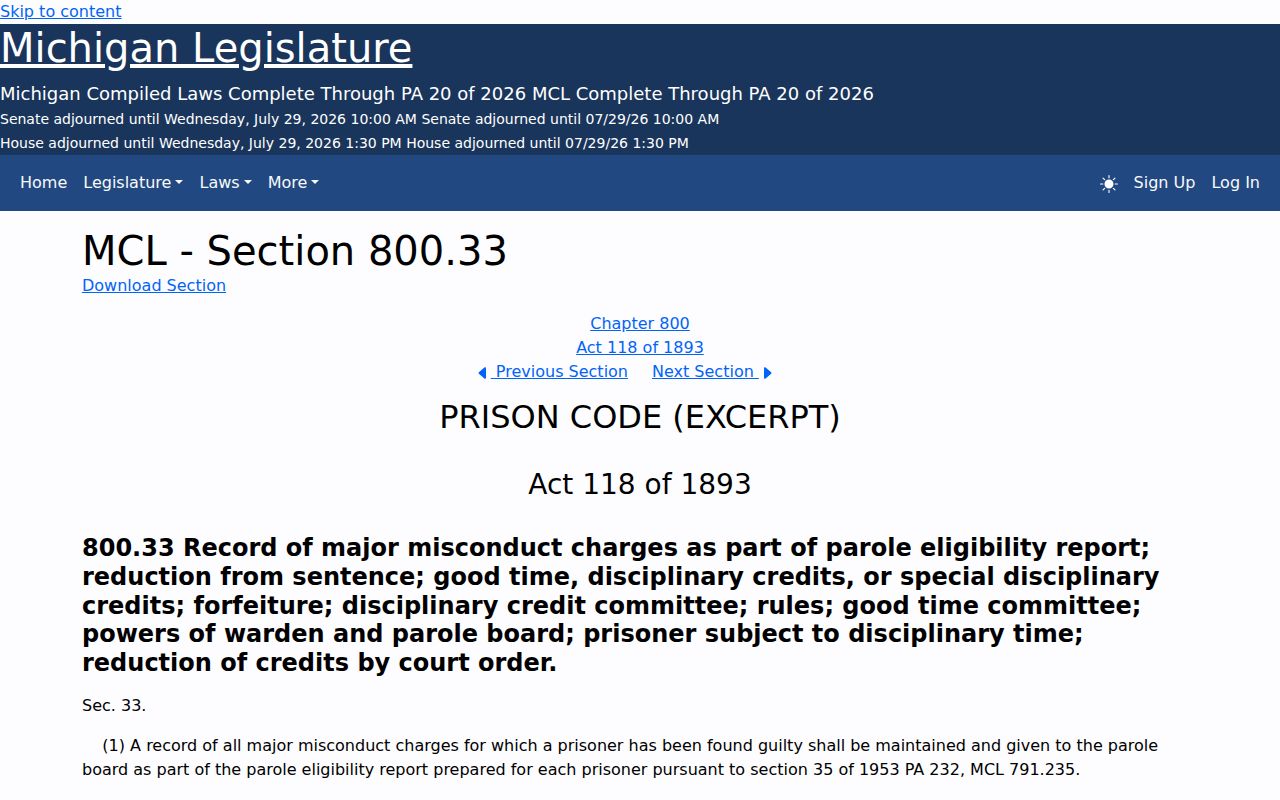
The statute image anchors the credit discussion in Michigan law, but MDOC must apply that law to the individual sentence.
Why Alcona Release Dates Change
A displayed date can move for legal, administrative, or conduct reasons. Some changes alter eligibility. Others affect only when a person physically leaves or where the person goes next. A detainer, for example, may not change the end of one sentence, yet it can prevent return to the community.
| Factor | Effect on the date or event |
|---|---|
| Corrected sentence data | MDOC recalculates fields when the judgment or recorded term was wrong |
| Consecutive sentences | Terms may extend Board jurisdiction or the maximum beyond a single sentence |
| Resentencing or court order | A new judgment can change the minimum, maximum, jail credit, or sentence structure |
| Eligible credit earned or lost | Older eligible sentences can move when credits are awarded, withheld, or forfeited |
| Misconduct or adverse information | Can affect credits or suspend a favorable parole decision before physical release |
| Parole grant, denial, or deferral | ERD permits review, while the Board's action determines whether release proceeds or review continues |
| Warrant, detainer, or transfer | May send the person to another custodian even when the current custody episode ends |
OTIS warns that status, location, and date information can change. For a consequential date, compare the judgment of sentence, offense dates, concurrent or consecutive terms, jail credit, and the current MDOC calculation. Do not subtract a flat percentage from the sentence.
Placement planning can also affect physical release after a favorable parole decision. A valid parole order and the absence of intervening adverse information matter. If new misconduct arises, the decision can be suspended before the person leaves. This is another reason the jurisdiction date, Board result, and actual Date Paroled must be treated as separate fields.
Confirm an Alcona Release Date
For a state prisoner, OTIS is the discovery tool. A formal record can be requested through MDOC FOIA, including an available discharge certificate or relevant file component. If the alleged error derives from a court judgment, contact the sentencing court. If it concerns status or supervision, contact the appropriate MDOC parole/probation office.
OTIS keeps current-supervision records and discharged records for three years after discharge. That makes it useful for a recent state sentence but not a full lifetime history. An older missing record is not proof that no prison term or release occurred. Ask MDOC for the named record and use the sentencing court's judgment when the public result has aged out.
For county custody, ask Alcona for the booking, bond-out, or movement entry and identify the receiving agency. If Iosco housed the person overnight, request the Iosco release event as well. MiCOURT can show the bond, disposition, sentence, or commitment, but a case event is not the jail's physical release timestamp.
Michigan VINE can send an agency-reported custody-change alert before or near an event. Registration steps and transfer limits are explained on the Alcona County VINE Inmate Check. Always pair an alert with the custodian's record when the exact time or destination matters.
Note: A release alert may close one agency's custody while another agency immediately assumes control.
Alcona Truth-in-Sentencing Dates
Michigan does not have a universal “serve 85 percent” rule. For covered truth-in-sentencing offenses, the prisoner serves the full judicial minimum in a secure facility before parole consideration. MDOC identifies specified assaultive crimes committed on or after December 15, 1998, and all other crimes committed on or after December 15, 2000, within the described framework. Disciplinary time is considered by the Board, but good time does not reduce that covered minimum.
The official MDOC Truth in Sentencing explanation states the secure-minimum rule.
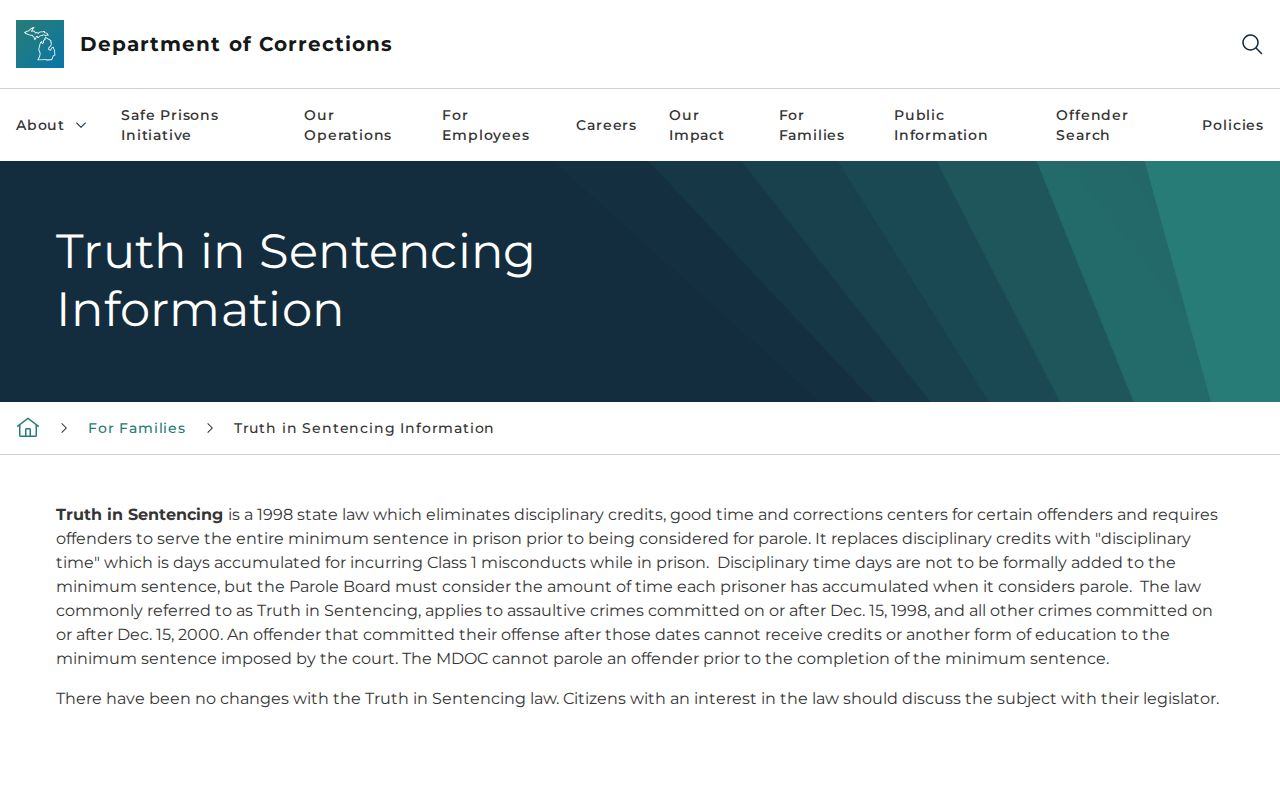
The image supports the key correction: parole consideration begins after the entire covered minimum, not after an assumed percentage.
MCL 791.234 supplies the detailed Board-jurisdiction rules, including treatment of disciplinary-time sentences and consecutive terms. Because the statute contains exceptions and sentence-specific provisions, its text and the judgment must be read together.
The Board applies a separate release standard after jurisdiction begins. It may grant, deny, or defer. A denial produces a later review point rather than an automatic date at the maximum, and a grant can still be held before movement if new facts arise. Ordinary parole interviews also are not all public hearings. Public notices for lifer-law, commutation, or pardon matters should not be mistaken for a full calendar of routine release dates.
Alcona County Jail Date Rules
An Alcona County jail sentence does not acquire an OTIS projected date. Michigan statutes, including MCL 801.257 and MCL 51.282, address county-jail good-time frameworks, but the person's eligibility, forfeiture, sentencing order, jail credit, and sheriff calculation still have to be verified in the actual record. The Alcona Sheriff’s corrections page supplies the local booking-and-transfer model, not a projected-date calculator.
No official Alcona policy was found that publishes an online county projected release date. No special weekend or holiday early-release practice was verified either. A date that lands on Sunday must not be moved to Friday by assumption. Ask the physical custodian for the existing computation and release record.
This local route can involve two counties. Alcona performs limited booking and bond processing but does not hold people overnight. A person who cannot post bond may be lodged in Iosco. The Alcona record documents the first custody endpoint or transfer, while Iosco's record controls the later jail release. The court judgment and jail-credit entry then explain the sentence basis.
A focused records request should name the person, give a narrow date range, and ask for the existing sentence computation, booking or movement entry, release date and time, release authority, and destination or receiving agency. The agency does not have to create a new calculation or summary. The Alcona County FOIA hub links the current local forms and procedures. Asking for the record maintained in the ordinary course is more precise than asking staff to predict when someone will leave.
The court can supply the judgment of sentence, disposition, and jail-credit information. The 81st District Court covers misdemeanors and the preliminary stage of felonies, while the 23rd Circuit Court holds the felony judgment. When the record shows a prison commitment, move from the county path to MDOC. When it shows a county term, stay with the physical jail and its computation. That routing prevents a court date from being reported as the date someone walked out.