
No Official Alcona 72-Hour Releases
No verified Alcona County Sheriff web page offers a 72-hour release feed, fixed three-day archive, or historical booking screen with release timestamps. No public field list, update cadence, display-retention rule, released-person photograph screen, or official mobile app was found. A commercial page that calls itself a recent roster does not become a county source. The accurate fallback is to define the period and seek the records kept by the agencies that handled custody.
Alcona’s custody model makes this absence especially important. The local facility does not hold people overnight. Some misdemeanor defendants pass through booking and post bail, while a person who cannot post is transported to Iosco County Jail. An arrest made while the Alcona facility is unstaffed can be lodged directly in Iosco. A useful three-day review must therefore look across both counties when the movement record points there.
Request Alcona Three-Day Release Records
A three-day inquiry works best as a defined record request. Choose the start date and time, the end date and time, and the release details needed. If the goal is one person’s history, request the named booking and movement entries. If the goal is every transaction in the period, ask for an existing release log, report, or export maintained in the ordinary course. Michigan FOIA does not require the sheriff to create a new compilation.
- Set the exact three-day range, including times and the local time zone, so there is no uncertainty at either edge.
- Call the Alcona sheriff or jail line at 989-724-6271 to ask whether local booking, bond-out, or transport occurred during that span.
- When Alcona identifies Iosco lodging, seek Iosco’s admission and eventual release transaction for the same person.
- Check MiCOURT Case Search for bond, dismissal, jail credit, sentence, probation, or commitment entries.
- Submit a focused request through the Alcona County FOIA hub for existing booking, bond-out, release, and transport records.
- Continue to MDOC, federal, immigration, or another county source if the movement record names that agency.
The county’s response period makes FOIA a verification tool, not a live feed. Alcona generally responds within five business days and may issue one extension for up to ten more business days. That timing can still serve a weekend review because the result preserves the agency’s record rather than a short-lived web display.
Note: Ask for an existing ordinary-course export if one exists; do not require staff to invent a new Alcona 72-hour list.
Alcona 72-Hour Release Fields
Alcona has no public 72-hour feed columns to quote. These are the record fields to identify in a focused request, if the agency maintains them. The destination field is vital. It resolves whether the person went home, entered Iosco custody, moved to state prison, or was picked up under another authority. A release date without its type and destination is incomplete.
| Existing record field | Reason to request it |
|---|---|
| Name, birth detail, booking number | Separates the right person and custody episode from similar records. |
| Booking date and time | Places the arrest or self-surrender inside or outside the selected range. |
| Release date and time | Dates the close of that agency’s custody episode. |
| Release authority or type | Identifies bond, recognizance, time served, court discharge, sentence completion, or transfer. |
| Movement and destination | Shows whether custody continued at Iosco or with another agency. |
| Arresting agency and case number | Connects the jail transaction with the proper court and legal order. |
| Booking photograph, if maintained | May aid identification but does not prove release or current status. |
Ask for exact fields rather than a narrative answer. The sheriff need not respond to questions or summarize several systems. If no release sheet exists, request the booking record and the custody-status or movement entry that closed it. If the disposition says transfer, ask for the receiving agency. That agency’s later record is needed to establish when all secure custody ended.
Weekend Alcona Release Verification
A three-day range is useful when a release may have occurred late in the week, the family learned of it after offices closed, or data entry happened after physical movement. Still, no official Alcona rule says that a weekend or holiday release appears in a later online batch. There is no published batch at all. Set the range around the actual dates and ask the custodian for its timestamps.
Do not assume a sentence ending on a Sunday was moved to Friday. No official Alcona weekend or holiday early-release policy was found. Likewise, a court order entered before the weekend does not prove the moment a person left. Bond may not have been posted, a transport may not have occurred yet, or another hold may have remained. The sheriff or serving jail movement record supplies the physical event.
| Three-day clue | What it can prove | Required check |
|---|---|---|
| Bond order | A judge authorized release on stated terms. | Confirm posting and departure with the custodian. |
| Time-served sentence | The court credited enough confinement in that case. | Check the actual release time and any other hold. |
| Alcona transfer entry | The local booking closed. | Contact Iosco or the named receiving agency. |
| VINE release alert | The reporting agency sent a custody-change event. | Confirm destination and possible follow-on custody. |
For a tight same-day event, the Alcona County 24-hour release workflow starts with an immediate phone and destination check. The three-day process is broader and relies more heavily on exact range requests and a complete custody chain.
Why Alcona Release Names Go Missing
No public Alcona roster-retention rule says a released name remains visible for three days. In fact, no official recent-release roster was verified. Many Alcona arrests also bypass overnight local lodging. A person may have a short booking-and-bond record, go directly to Iosco, or be handed to another custodian. A blank search result cannot distinguish these paths.
The official Sheriff Corrections page is the key local source because it explains both the limited Alcona role and the Iosco lodging route. It does not provide a release list, but it tells the researcher where the proof chain must go. The screenshot below preserves that operational context:
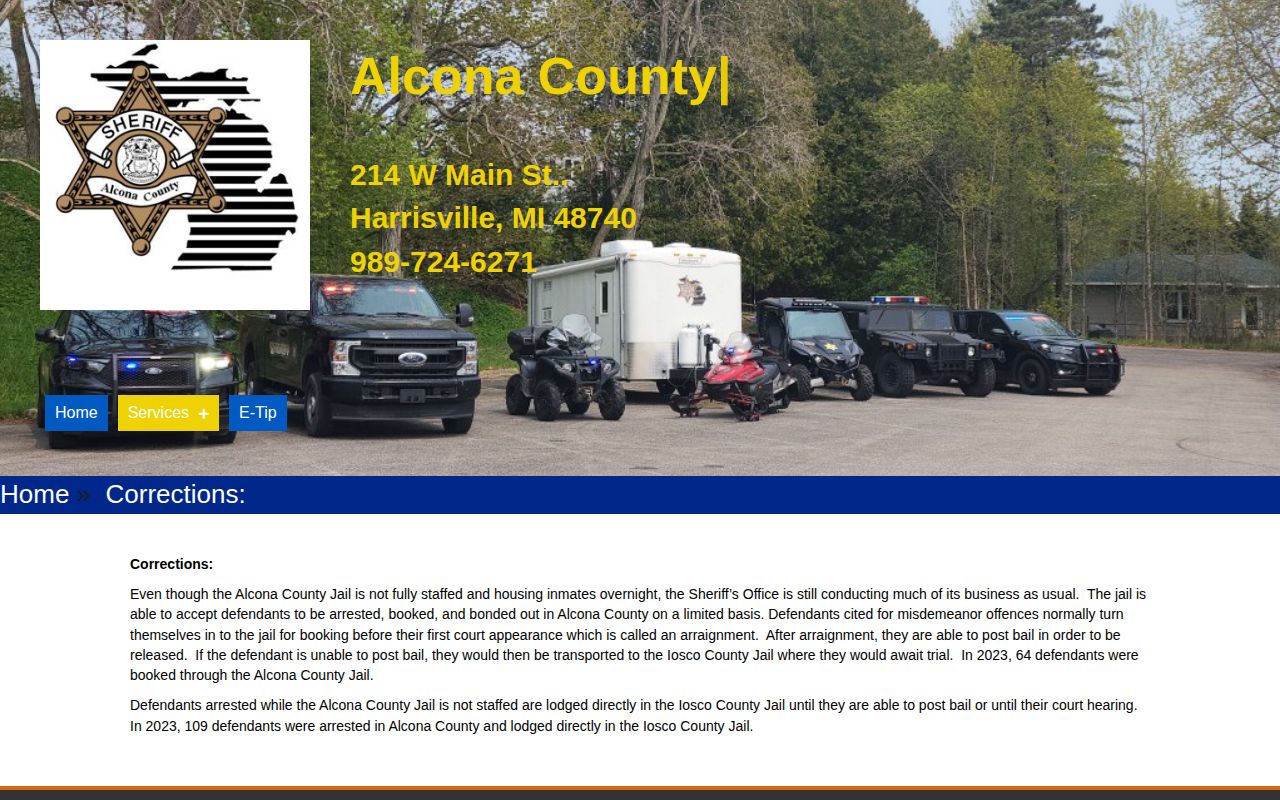
Follow with person-specific records. Ask Alcona whether it created a booking or transport entry, then ask Iosco for the release event if it housed the person. Do not use disappearance, “not found,” or “not here” as a synonym for community release.
- Not found
- The searched system returned no match under the entered criteria. It does not state where the person is.
- Transferred
- One agency ended its custody while another agency took control.
- Released
- A reported agency event ended that custody episode, subject to the destination and any other hold.
Trace Alcona and Iosco Custody
A complete three-day record can cross county lines. Start with Alcona for an arrest, self-surrender, booking, bond transaction, or transport. Use Iosco for the overnight custody that follows when bail is not posted or local staff is unavailable. A transport entry is not the same as an Iosco release record. Both may be needed to describe the full period accurately.
The court trail runs in parallel. The 81st District Court handles misdemeanors and felony preliminary proceedings in Alcona County. The 23rd Circuit Court handles felony judgment and sentencing. A district bond order can explain why release was permitted. A circuit commitment can explain why county custody ended through transfer to MDOC. Neither court screen serves as the jail’s departure log.
A request should preserve agency names and transaction times at each step. If Alcona never booked the person because the arrest went straight to Iosco, say so. If Alcona booked the person and then transferred them, do not collapse those two events into one. Clear custody labels prevent a county record from being mistaken for proof that the person returned to the community.
Note: The agency that physically held the person is the best source for that agency’s exact admission, movement, and departure time.
Alcona Release Alerts and Records
Michigan VINE and public-record requests serve different roles. VINE is designed for custody-change notifications. Search the Michigan VINE interface, match the name or identifier and reporting agency, and register only against the correct record. An alert can report release, transfer, or another supplied event. Data can lag, and an Alcona or Iosco event does not rule out a new custodian.
FOIA supplies documents after the fact. Identify the person, date of birth or booking number when known, the exact three-day range, and the desired existing records. Ask for release date and time, release type or authority, destination, and receiving agency. For a group of transactions, add “if maintained in the ordinary course” to the request for a log or export. The agency can review records for exemptions and redaction.
MDOC OTIS is a third path, but only for state jurisdiction. A person whose only custody was an Alcona or Iosco county-jail stay may not appear there. When the court or movement record shows commitment to MDOC, search OTIS for parole, discharge, or current supervision. Parole means secure prison custody ended while the sentence continued under supervision. Discharge means the listed MDOC jurisdiction ended.
Confirm an Alcona Release Claim
A three-day list inquiry asks which release transactions occurred in a set range. A named-person inquiry can reach beyond that window. Use the Alcona County released-inmate lookup when the date is uncertain or the record may sit with MDOC, a federal custodian, or the courts. Keep the systems separate while comparing their dates.
For county custody, the strongest result names the booking, release time, release authority, and destination. For state prison, OTIS and an MDOC record can establish parole or discharge. A federal BOP result does not prove release from Alcona County Jail, and an ICE locator result concerns immigration custody. One system’s “not in custody” statement cannot be expanded to all agencies.
End the review with a plain description of the evidence. “Alcona transferred the person to Iosco” is not “Alcona released the person home.” “The court authorized bond” is not “bond was posted.” “VINE reported an agency release event” is not “all custody ended.” A precise record chain is the reliable substitute for a three-day feed that the county does not publish.